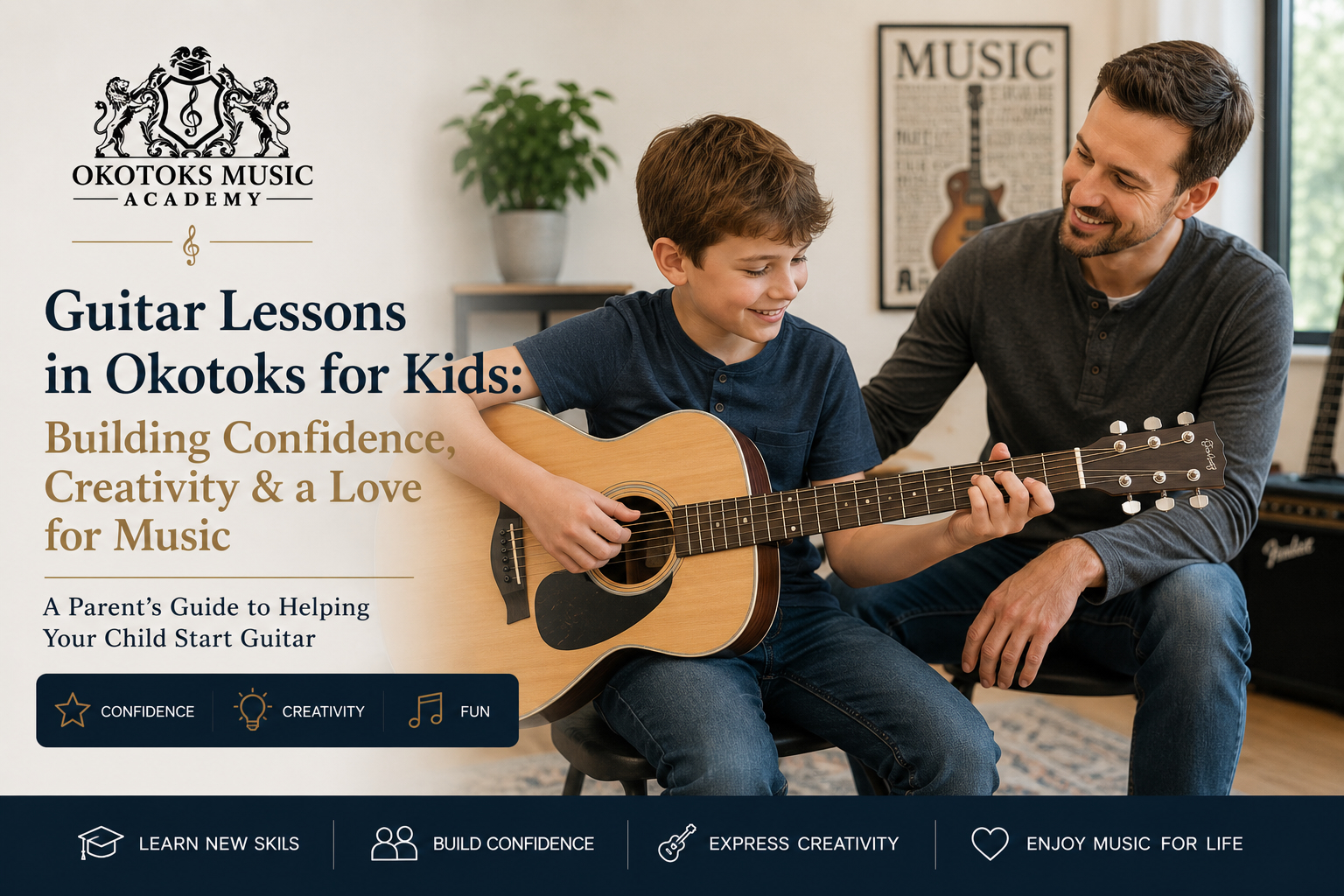
Guitar Lessons in Okotoks for Kids: A Parent’s Guide to Starting Strong
Guitar Lessons in Okotoks for Kids:
A Parent’s Guide to Starting Strong
If your child has been asking to learn guitar, you may be wondering whether now is the right time to start.
Maybe they have seen someone play acoustic guitar at church, watched a guitarist online, noticed an electric guitar in a music video, or simply like the idea of playing songs they recognize. Guitar has a natural appeal for kids because it feels creative, expressive, and personal.
But parents usually have practical questions before signing up for lessons.
You may be asking:
What age is best to start guitar?
Is guitar too hard for young kids?
Should my child start on acoustic, electric, or ukulele?
Do we need to buy a guitar right away?
How much practice is realistic?
Are private guitar lessons better than learning online?
How do we keep lessons fun without losing structure?
These are the right questions.
At Okotoks Music Academy, private guitar lessons for kids are designed to help young students build confidence, coordination, rhythm, listening skills, and a genuine love for music. The goal is not simply to teach chords. The goal is to give children a positive first experience with guitar so they want to keep learning.
This parent guide explains what Okotoks families should know before starting guitar lessons, how to choose the right instrument, what kids learn in the beginning, and how to help your child succeed.
Why Guitar Is a Great Instrument for Kids
Guitar is one of the most popular instruments for children because it connects quickly to songs students already know.
Many kids are drawn to guitar because it feels modern and expressive. They may imagine themselves strumming songs, playing in a band, writing music, or performing for family. That emotional connection can be powerful.
Guitar also gives students a practical musical foundation.
Children who take guitar lessons can develop:
rhythm
coordination
listening skills
finger strength
focus
confidence
creativity
pattern recognition
patience
musical independence
Unlike some activities where children need to wait a long time before something feels useful, guitar can introduce recognizable sounds fairly early. Even simple strumming patterns and beginner chords can feel musical.
That said, guitar can also be physically challenging at first. The strings can feel uncomfortable. Chord shapes can be awkward. Fingers need time to build strength and coordination.
That is why the beginning matters.
If a child is pushed too hard too soon, they may decide guitar is “too hard.” But if lessons are structured properly, the early stage can be encouraging and manageable.
For families searching for kids guitar lessons in Okotoks, the most important thing is finding a teacher who understands how to make the first few months both productive and positive.
What Is the Best Age to Start Guitar Lessons?
Many children are ready to start guitar somewhere around ages 7 to 9, but age is not the only factor.
Some younger children can begin earlier, especially with ukulele or a properly sized guitar. Some children may do better waiting until their hands are larger, their attention span is stronger, or their motivation is clearer.
A child may be ready for beginner guitar lessons if they can:
follow simple instructions
focus with a teacher for a short lesson
handle small frustrations
use their fingers independently
practice briefly at home
show interest in music or guitar
sit with an instrument safely
repeat simple patterns
The physical side matters more on guitar than on piano. Pressing strings takes finger strength. Holding chord shapes takes coordination. Strumming while changing chords takes patience.
This does not mean children should wait until everything is easy. Learning an instrument is supposed to stretch them. But the teacher needs to choose the right starting point.
For some younger students, ukulele can be a better first step. The ukulele is smaller, has fewer strings, and is often easier for small hands. It can build rhythm, strumming, chord awareness, and confidence before moving to guitar later.
For other students, a properly sized guitar works well from the start.
The best choice depends on the child.
Acoustic Guitar, Electric Guitar, or Ukulele: What Should Kids Start With?
Parents often assume every beginner should start with acoustic guitar. That can work, but it is not always the only good option.
Each instrument has advantages.
Acoustic Guitar
Acoustic guitar is a common starting point because it does not require an amplifier and works well for strumming, singing, worship songs, folk songs, pop songs, and general music learning.
However, acoustic strings can feel harder on the fingers at first, especially for younger children.
A smaller-bodied acoustic guitar may be better than a full-size one for kids.
Electric Guitar
Electric guitar can actually be easier on the fingers because the strings are usually lighter and closer to the fretboard. This can help some beginners feel successful sooner.
The downside is that electric guitar requires an amplifier, cable, and more setup. It can also encourage students to focus on sound effects before fundamentals if not guided well.
Electric guitar can be a good fit for kids who are highly motivated by rock, pop, worship band music, or lead guitar sounds.
Ukulele
Ukulele is often excellent for younger children. It is smaller, lighter, and has four strings instead of six. Chords can be easier to learn, and students can start strumming simple songs fairly quickly.
The ukulele can be a confidence-building bridge into guitar.
Which One Is Best?
The best first instrument is the one that fits the child’s size, interests, and patience level.
A motivated 10-year-old may do very well on acoustic or electric guitar. A younger child with smaller hands may be better starting on ukulele. A child who loves electric guitar sounds may stay more engaged if lessons include that style.
Before buying, it is smart to ask a guitar teacher for guidance. Buying the wrong size instrument can make learning harder than it needs to be.
What Size Guitar Does a Child Need?
A properly sized guitar makes a major difference.
If a guitar is too large, the child may struggle to reach around the body, press the strings, or form chords comfortably. This can create frustration before the student has a fair chance to learn.
Children may need:
a 1/2-size guitar
a 3/4-size guitar
a smaller-bodied acoustic guitar
a beginner electric guitar
a ukulele as a first step
The right size depends on age, height, hand size, and instrument type.
Parents should avoid buying the cheapest full-size guitar without checking fit. A poor-quality guitar with high strings can be painful and discouraging for a beginner. It may make the child think they are the problem when the instrument is actually making things harder.
A good beginner guitar does not need to be expensive, but it should be playable.
Look for:
comfortable size
strings that are not too high
tuning stability
decent sound
safe condition
good setup if possible
A teacher can usually tell quickly whether an instrument is helping or hurting the student.
What Do Kids Learn in Beginner Guitar Lessons?
Beginner guitar lessons should be structured in a way that builds confidence and skill together.
A young beginner may learn:
How to Hold the Guitar
Students learn how to sit with the guitar, hold it safely, and position their hands.
This matters because poor posture can make playing harder.
String Names
Students learn the names of the strings and how the guitar is organized.
Basic Finger Placement
Students learn how to press strings behind the frets and use their fingertips properly.
This can take time. The fingers may feel awkward at first.
Simple Rhythms
Rhythm is one of the most important parts of guitar. Students may clap, count, tap, and strum simple patterns.
Beginner Chords
Students start with simple chord shapes. The exact chords depend on age, hand size, and teacher approach.
Some students may begin with one-finger chords or simplified versions before moving to full chord shapes.
Strumming Patterns
Strumming helps students feel like they are making real music. Even simple downstrokes can be exciting for a beginner.
Simple Songs
Early songs should be achievable and motivating. A child should feel that they can play something recognizable.
Practice Habits
Students learn how to practice slowly, repeat carefully, and build small improvements.
A good teacher does not only teach songs. They teach the student how to learn.
Is Guitar Hard for Kids?
Guitar can be challenging at first, but that does not mean it is a bad choice.
The first few weeks may include:
sore fingertips
buzzing strings
slow chord changes
trouble strumming evenly
difficulty using both hands together
frustration when fingers do not cooperate
This is normal.
Parents should not panic if the first stage feels awkward. Every guitarist goes through it.
The key is keeping expectations realistic.
A beginner child does not need to play full songs perfectly right away. They need to build basic comfort, rhythm, finger strength, and confidence.
Small wins matter.
A child might start by learning one chord, then two chords, then a simple rhythm, then part of a song. Each step builds momentum.
The teacher’s job is to make those steps clear and achievable.
How Much Should Kids Practice Guitar?
For young beginners, short and consistent practice is best.
A realistic starting point is:
5 to 15 minutes per day, several days per week.
Older or more motivated students may practice longer.
The goal is not to force long practice sessions. The goal is to create a habit.
A good beginner practice routine might include:
tuning with help
reviewing one chord
practicing a simple strum
playing one short song
repeating a small section slowly
ending with something fun
Parents can help by making practice predictable and positive.
Instead of saying, “Go practice guitar,” try asking:
“Can you show me your new chord?”
“What song are you working on?”
“Can you play that rhythm three times?”
“What did your teacher ask you to practice?”
“Which part feels easiest today?”
Parents do not need to know guitar to support practice. They simply need to help protect the routine.
Should Kids Learn Guitar from YouTube?
YouTube can be useful, but it is not the same as private guitar lessons.
A video cannot see your child’s hands. It cannot correct finger placement. It cannot tell whether the guitar is too large. It cannot notice tension, poor posture, wrong strumming, or frustration. It cannot adjust the lesson when a child is confused.
For beginners, those details matter.
Private guitar lessons give students feedback in real time.
A good guitar teacher can say:
“Move your finger closer to the fret.”
“Relax your wrist.”
“Try a smaller chord shape first.”
“Slow the strum down.”
“This guitar may be too big.”
“Let’s use a song that fits your level better.”
That kind of guidance can prevent discouragement.
Online tools can support lessons, but for most children, they should not replace a good teacher.
What Makes a Good Guitar Teacher for Kids?
A good kids guitar teacher needs more than guitar skill.
They need to know how to work with children.
A strong beginner guitar teacher should be able to:
explain clearly
encourage without overpraising
correct kindly
choose age-appropriate songs
adjust to hand size and attention span
build rhythm and technique
keep lessons structured
make early progress feel possible
communicate with parents
understand when to slow down or simplify
The teacher should also understand that children are not all motivated the same way.
Some kids want to play popular songs. Some want to write music. Some want to play electric guitar. Some want to sing and strum. Some are shy. Some are energetic. Some need extra repetition.
A good teacher adapts without losing the foundation.
For parents searching for a guitar teacher in Okotoks, personality and teaching approach matter as much as musical ability.
What If My Child Gets Frustrated?
Frustration is part of learning guitar.
The goal is not to remove every challenge. The goal is to help the child handle challenge without quitting immediately.
Guitar can teach children patience because progress is visible but not instant. Fingers get stronger. Chords get cleaner. Strumming becomes steadier. Songs become easier.
Parents can help by normalizing the process.
You might say:
“It is supposed to feel awkward at first.”
“Your fingers are learning something new.”
“You only need to improve a little at a time.”
“Let’s practice the small part your teacher assigned.”
“You are better than last week.”
Avoid turning frustration into pressure.
If a child is consistently upset, the teacher may need to simplify the material, adjust the instrument, change songs, or create smaller practice goals.
Sometimes one small adjustment fixes the problem.
Can Guitar Help Build Confidence?
Yes.
Guitar can be a strong confidence-building activity for children because it gives them a skill they can see and hear improving.
At first, a child may not be able to play a chord. Then they can. At first, a strum may sound uneven. Then it becomes steady. At first, a song may seem impossible. Then they can play part of it.
That process teaches children that effort creates progress.
Guitar also gives children a way to express themselves. Some children are not drawn to competitive sports or large group activities. Music can give them a personal skill and creative outlet.
Not every child needs to perform on stage. Some children simply need something positive that helps them grow.
Guitar can do that.
Why Local Guitar Lessons in Okotoks Matter
Convenience matters for families.
If lessons are local and easy to fit into the weekly schedule, students are more likely to attend consistently and keep progressing.
For Okotoks families, local guitar lessons can make music more practical. Parents do not need to turn lessons into a long drive or complicated weekly commitment.
But local does not only mean close.
It should also mean relevant.
Families searching for guitar lessons near me in Okotoks are usually looking for a place where their child can feel comfortable, learn properly, and build confidence over time.
The right environment matters.
Children need structure, encouragement, and a teacher who knows how to make guitar feel possible.
Common Questions About Guitar Lessons for Kids
What age should kids start guitar lessons?
Many children are ready around ages 7 to 9, but some can start earlier with the right instrument, especially ukulele. Readiness depends on focus, hand size, interest, and ability to follow instructions.
Is guitar harder than piano for kids?
Guitar can be harder physically at first because pressing strings requires finger strength. Piano is more immediate, while guitar may take more patience in the beginning. Both can be excellent instruments.
Should my child start with acoustic guitar or electric guitar?
Either can work. Acoustic is simple and portable. Electric can be easier on the fingers but requires more equipment. The best choice depends on the child’s interests and size.
Is ukulele a good first instrument before guitar?
Yes. Ukulele can be a good first step for younger children because it is smaller and easier to handle. It can teach rhythm, chords, and strumming before moving to guitar.
Do we need to buy a guitar before the first lesson?
It is helpful to have an instrument at home, but it is wise to ask for guidance before buying. The wrong size or poor-quality guitar can make learning harder.
How long does it take for kids to play songs?
Many beginners can start simple songs or parts of songs within the first few lessons. Clean chord changes and steady rhythm take longer.
How often should kids take guitar lessons?
Weekly private lessons are usually best because they provide consistency, feedback, and steady progress.
Can my child learn songs they like?
Yes. A good teacher can include student-interest songs while still teaching proper fundamentals.
Final Thoughts: Starting Guitar the Right Way
Guitar can be an excellent instrument for kids, but the first experience matters.
A child who feels overwhelmed, uncomfortable, or unsupported may quit early. A child who feels encouraged, guided, and successful is more likely to keep going.
The right guitar teacher can help your child build rhythm, coordination, finger strength, creativity, and confidence in a way that feels manageable and enjoyable.
At Okotoks Music Academy, we offer private guitar lessons for children and beginners in a supportive one-on-one setting. Our goal is to help students learn properly, enjoy the process, and build skills that can last for years.
Okotoks Music Academy offers private music lessons in piano, guitar, and voice for students in Okotoks and surrounding areas.
If your child is ready to start guitar lessons in Okotoks, contact Okotoks Music Academy to ask about current lesson availability.
