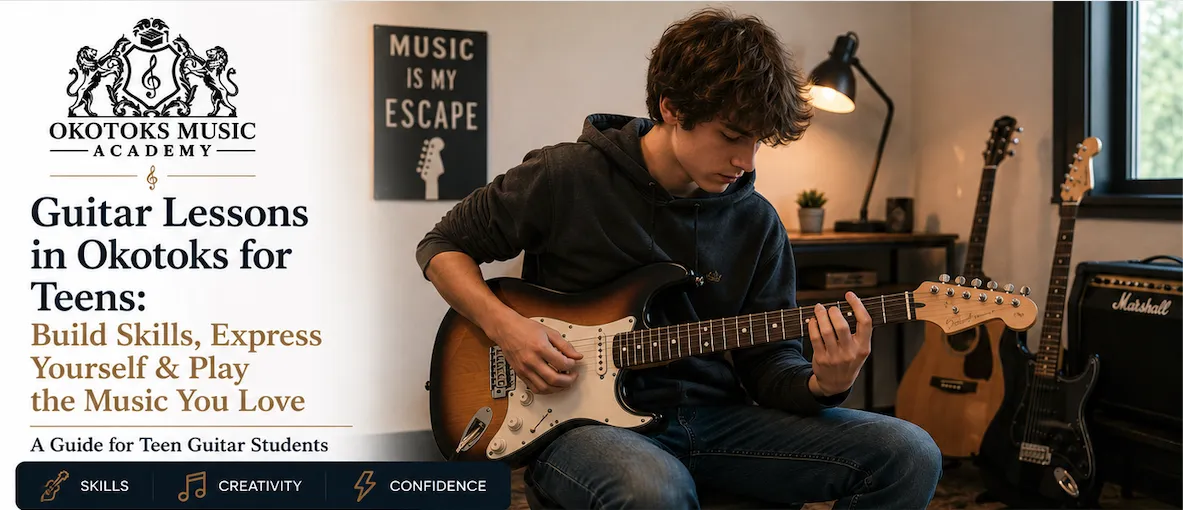
Guitar Lessons in Okotoks for Teens: Build Skills, Express Yourself, and Play the Music You Love
Guitar Lessons in Okotoks for Teens:
Build Skills, Express Yourself, and Play the Music You Love
The teenage years are full of change, discovery, pressure, creativity, and self-expression.
For many teens, music becomes more than an activity. It becomes a way to express identity, manage stress, connect with friends, worship, write songs, or simply enjoy something that feels personal.
That is one reason guitar can be such a strong instrument for teenagers.
Guitar is portable, versatile, and connected to many styles of music teens already care about. A teen may want to learn acoustic guitar, electric guitar, worship songs, pop music, rock riffs, fingerpicking, songwriting, or songs they have heard online. They may want to play alone in their room, perform at school, join a band, play at church, or just build a skill that feels meaningful.
At Okotoks Music Academy, private guitar lessons for teens are designed to help students build real musical skill while keeping lessons connected to their interests. A teenager does not need to be treated like a young child. They need structure, but they also need ownership. They need technique, but they also need music they actually want to play.
This guide explains how teen guitar lessons in Okotoks can help students build confidence, creativity, discipline, and musical independence.
Why Guitar Is a Strong Choice for Teenagers
Guitar fits the teenage stage of life well.
It gives students a practical way to make music quickly, but it also has enough depth to keep challenging them for years. A teen can start with basic chords and simple songs, then move into more advanced rhythm, lead guitar, fingerstyle, improvisation, songwriting, music theory, and performance.
Guitar lessons can help teens develop:
confidence
creativity
focus
rhythm
coordination
discipline
patience
musical expression
performance skills
independence
songwriting ability
a healthier outlet for stress
Unlike some activities that end after a season, guitar can become a lifelong skill.
A teen who learns guitar can carry that skill into adulthood. They can use it at home, with friends, in worship, in a band, while writing songs, or simply as a personal creative outlet.
That long-term value matters.
Is It Too Late to Start Guitar as a Teen?
No. The teen years are an excellent time to start guitar.
Some parents worry their teen is behind if they did not start music lessons as a young child. That is usually not a useful way to think.
Teenagers often learn quickly because they can understand instructions, recognize patterns, and focus on goals. They may also have a clearer sense of what music they like. That personal interest can increase motivation.
A 13-year-old, 15-year-old, or 17-year-old can start guitar and make strong progress with consistent lessons and practice.
In fact, teens often have an advantage over younger students because they can connect guitar to real musical goals:
“I want to play this song.”
“I want to learn electric guitar.”
“I want to play worship music.”
“I want to write songs.”
“I want to play with friends.”
“I want to get better for school music.”
“I want a creative outlet.”
That kind of motivation is powerful.
The key is matching lessons to the teen’s goals while still building proper fundamentals.
Acoustic Guitar or Electric Guitar for Teens?
Both acoustic and electric guitar can be good options for teens.
The better choice depends on the student’s musical interests, physical comfort, and long-term goals.
Acoustic Guitar
Acoustic guitar is a strong choice for students who want to strum songs, sing along, play worship music, learn singer-songwriter styles, or enjoy a simple setup without an amplifier.
Acoustic guitar is portable and practical. It works well for campfire songs, church music, pop songs, folk music, and rhythm guitar.
However, acoustic guitar can be harder on the fingers at first because the strings may require more pressure.
Electric Guitar
Electric guitar can be easier to play physically because the strings are often lighter. It can be a strong choice for teens interested in rock, pop, blues, lead guitar, riffs, solos, worship band music, or amplified performance.
Electric guitar does require more gear, including an amplifier and cable. But for some teens, the sound and feel of electric guitar are highly motivating.
Which Should a Teen Choose?
The best first guitar is usually the one the student is most excited to play, as long as it is properly sized and playable.
If a teen loves electric guitar, forcing them to start with acoustic may reduce motivation. If they want to sing and strum, acoustic may be a better fit. If they are unsure, a teacher can help guide the decision.
The most important thing is that the instrument is comfortable, in good condition, and supports consistent practice.
What Do Teens Learn in Beginner Guitar Lessons?
Teen guitar lessons should build a foundation without feeling childish. Choosing the right teacher is very important.
Beginner teen students usually learn:
Guitar Setup and Tuning
Students learn the parts of the guitar, how the instrument works, and how to tune it. Tuning is important because students need to hear music correctly from the beginning.
Chords
Chords are central to guitar. Teens often begin with basic open chords and simplified chord shapes, then build toward smoother changes and more advanced progressions.
Strumming Patterns
Strumming gives songs rhythm and movement. Students learn how to keep a steady beat, coordinate the strumming hand, and play different rhythmic patterns.
Riffs and Melodies
Many teens enjoy learning recognizable riffs or short melodic ideas. This can be especially motivating for electric guitar students.
Finger Strength and Technique
Guitar requires finger strength, accuracy, and coordination. Students learn how to place fingers properly, reduce buzzing, and move efficiently.
Reading Guitar Tablature
Many guitarists use tablature, often called tabs. Tabs can help students learn riffs, melodies, and songs.
Reading Music
Some students also learn standard notation, especially if they want broader musicianship, school music support, or more advanced study.
Music Theory
Theory helps students understand chords, scales, keys, and song structure. For teens interested in songwriting, theory can be especially useful.
Songs They Actually Want to Play
This matters. Teens are more likely to practice when they are working toward music they care about.
A good teacher balances fundamentals with music that motivates the student.
Can Teen Guitar Students Learn Their Favourite Songs?
Yes, and they should.
One of the best ways to keep teens engaged is to connect lessons to music they already enjoy.
That may include:
pop songs
rock songs
worship songs
country music
movie themes
video game music
acoustic singer-songwriter music
classic rock
blues
musical theatre
songs from social media
original music
However, not every song is beginner-friendly in its original form.
A good guitar teacher can simplify songs, choose appropriate sections, create easier versions, or use a song to teach a specific skill.
For example:
a pop song can teach chord progressions
a worship song can teach strumming
a rock riff can teach timing and finger placement
a blues pattern can teach improvisation
an acoustic song can teach fingerpicking
a favourite melody can teach tabs or note reading
The goal is not just to copy songs. The goal is to use songs to build skill.
That is how students become musicians, not just imitators.
Guitar Lessons and Songwriting for Teens
Many teens are interested in writing their own music.
Guitar is one of the best instruments for songwriting because it allows students to combine chords, rhythm, melody, and lyrics in a practical way.
Even beginner guitar students can start exploring simple creative ideas.
Teen guitar lessons may include:
chord progressions
strumming patterns
lyric support
melody ideas
song structure
rhythm changes
capo use
basic recording ideas
improvisation
arranging songs
playing and singing together
Songwriting can be especially meaningful for teens because it gives them a way to express thoughts and emotions in a healthy form.
Not every teen wants to write songs. But for those who do, guitar lessons can give them the tools to start creating instead of only consuming music.
Guitar as a Confidence Builder for Teens
Confidence is built through progress.
A teen may start guitar feeling unsure, awkward, or self-conscious. At first, the fingers do not cooperate. Chords buzz. Strumming feels uneven. Songs seem harder than expected.
But with practice and guidance, things change.
The student learns one chord. Then another. Then a rhythm. Then part of a song. Then a full song. Then a harder song.
That process creates evidence.
The teen can say:
“I could not do this before, and now I can.”
That matters.
Guitar also gives teens a skill that feels personal. It can become part of who they are. For some students, music becomes a safe place to grow confidence without needing to be loud, athletic, or socially dominant.
For shy teens, guitar can provide quiet confidence. For creative teens, it can provide expression. For anxious teens, it can provide focus and routine. For high-energy teens, it can provide a productive outlet.
This is why teen music lessons can be valuable beyond the instrument itself.
Private Guitar Lessons vs. Learning Online
Many teens try to learn guitar from YouTube, apps, or online tutorials.
These tools can be useful, but they have limits.
Online videos cannot see the student’s hands. They cannot correct poor technique. They cannot tell whether the guitar is too hard to play. They cannot explain why a chord is buzzing. They cannot adjust a song to the student’s level. They cannot build a structured plan.
Private guitar lessons give students feedback.
A teacher can help with:
finger placement
chord changes
strumming accuracy
rhythm problems
posture
tension
tuning
song selection
practice structure
technique
musical goals
This is especially important for beginners. Without feedback, students may practice mistakes for weeks or months.
Online tools can support learning, but private lessons usually create faster, cleaner, and more confident progress.
How Much Should Teens Practice Guitar?
Teen students can make good progress with consistent practice.
A realistic starting routine is:
15 to 30 minutes per day, 4 to 5 days per week.
Some highly motivated teens will practice more. Others need a smaller starting target.
Consistency matters more than occasional long sessions.
A good teen practice session may include:
tuning the guitar
reviewing chord changes
practicing one rhythm pattern
working on a difficult section slowly
playing part of a favourite song
reviewing teacher assignments
ending with something enjoyable
Parents should be careful not to turn practice into a fight.
Teens need ownership. Parents can help by protecting time and showing interest, but heavy pressure often creates resistance.
Better questions include:
“What song are you working on?”
“When do you want to practice this week?”
“Do you need a quieter space?”
“Is the guitar still feeling like the right fit?”
“What did your teacher give you to work on?”
That approach respects the teen while still supporting consistency.
Guitar Lessons for Worship, Bands, and Performance
Many teens want to use guitar in a real-world setting.
That might mean playing at church, joining a worship team, playing with friends, performing at school, joining a band, or playing at a recital.
Guitar lessons can help prepare students for those opportunities.
Depending on the student’s goals, lessons may include:
chord charts
rhythm guitar
lead guitar basics
worship chord progressions
playing with a metronome
playing along with recordings
performance preparation
stage confidence
improvisation
ensemble awareness
listening skills
Playing alone and playing with others are different skills.
A student may be able to play a song at home but struggle to stay in time with other musicians. Lessons can help bridge that gap.
For teens interested in group music settings, this is important.
What If a Teen Already Plays a Little Guitar?
Some teens start lessons after teaching themselves for months or years.
They may know a few chords, riffs, or songs, but still have gaps.
Common self-taught gaps include:
weak rhythm
poor finger placement
inconsistent timing
limited chord knowledge
no theory understanding
trouble changing chords smoothly
poor practice habits
tension
lack of musical structure
Private lessons can help clean up those gaps without making the student feel like they are starting over.
A good teacher will respect what the student already knows while helping them become stronger and more complete.
Self-taught experience can be useful. It shows interest. Lessons can turn that interest into better skill.
Why Local Guitar Lessons in Okotoks Matter for Teens
Teen schedules are busy.
School, sports, work, friends, church, family, and homework can make consistency difficult. Local lessons make it easier to keep music in the routine.
For Okotoks families, local guitar lessons can reduce travel time and help students stay consistent through the year.
When families search for guitar lessons near me in Okotoks, they are usually looking for convenience, but also for quality. They want a teacher who can connect with their teen, build real skill, and keep lessons relevant.
That combination is important.
A teen is more likely to stick with guitar when lessons feel useful, personal, and achievable.
Common Questions About Guitar Lessons for Teens
Is it too late to start guitar as a teenager?
No. Teens can start guitar successfully and often progress quickly because they understand goals, recognize patterns, and can practice more independently.
Should teens start with acoustic or electric guitar?
Either can work. Acoustic is great for strumming, singing, and worship music. Electric is great for rock, pop, riffs, lead guitar, and amplified styles. The best choice depends on the student’s interests.
Can my teen learn songs they like?
Yes. A good teacher can include music the student enjoys while still teaching proper technique, rhythm, chords, and theory.
Do teens need to read music to play guitar?
Not always. Guitar students may learn chords, tabs, rhythm, and standard notation depending on their goals. Reading music can be useful, but it is not the only path.
How often should teens take guitar lessons?
Weekly private lessons are usually best for steady progress, accountability, and skill development.
Can guitar lessons help with songwriting?
Yes. Guitar is excellent for songwriting because students can learn chords, progressions, rhythm, melody, and song structure.
What if my teen is self-taught?
Lessons can help self-taught players clean up technique, fill gaps, improve rhythm, and build a stronger musical foundation.
Do teens need to perform?
No, but performance can be valuable if the student is ready. Some teens enjoy performing, while others prefer private progress first.
Final Thoughts: Guitar Can Be a Strong Outlet for Teens
Teenagers need healthy outlets.
Guitar can give them a way to express themselves, build confidence, reduce stress, and develop a real skill. It can connect to the music they love while still teaching discipline, focus, rhythm, creativity, and perseverance.
The right lessons matter.
Teen guitar lessons should not feel childish or random. They should be structured enough to create progress and flexible enough to connect with the student’s goals.
At Okotoks Music Academy, we offer private guitar lessons for teens in a supportive one-on-one environment. Whether your teen is a complete beginner, self-taught player, acoustic guitarist, electric guitarist, songwriter, worship musician, or simply curious about learning, our goal is to help them build confidence and skill.
Okotoks Music Academy offers private music lessons in piano, guitar, and voice for students in Okotoks and surrounding areas.
If your teen is ready to start guitar lessons in Okotoks, contact Okotoks Music Academy to ask about current lesson availability.
