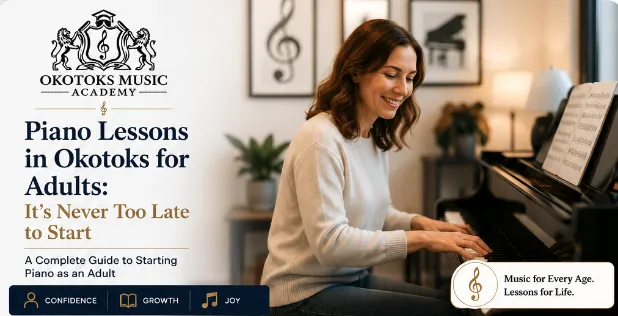
Piano Lessons in Okotoks for Adults: It’s Never Too Late to Start
Piano Lessons in Okotoks for Adults:
It’s Never Too Late to Start!
Many adults think about learning piano for years before they finally start.
Some took lessons as a child and wish they had kept going. Some always wanted to learn but never had the opportunity. Some are retired or approaching retirement and want a meaningful hobby. Others want a creative break from work, family responsibilities, screens, and the pace of everyday life.
If you are searching for adult piano lessons in Okotoks, the first thing to know is simple:
You are not too old to start.
Adults can learn piano. Seniors can learn piano. Complete beginners can learn piano. Returning players can rebuild old skills. The process may look different than it does for children, but in many ways adults bring advantages to lessons that younger students do not.
Adults usually understand why they are there. They have personal goals. They can connect music to memory, emotion, worship, family, creativity, and enjoyment. They may not always have unlimited practice time, but they often bring stronger life experience and clearer motivation.
At Okotoks Music Academy, private piano lessons for adults are designed to be encouraging, practical, and goal-focused. Whether you want to play simple songs, read music, learn chords, return to piano after years away, play for church, accompany your singing, improve brain health, or simply enjoy music at home, piano can become a rewarding part of your life.
This guide explains what adults and seniors can expect from piano lessons, how to get started, and why learning piano later in life is not only possible, but worthwhile.
Is It Too Late to Learn Piano as an Adult?
No. It is not too late.
This is the most common concern adults have before starting piano lessons. Many people assume that if they did not learn as a child, they missed their chance.
That is not true.
Children may learn quickly in certain ways, but adults have their own advantages. Adults can understand abstract ideas, recognize patterns, ask better questions, and connect practice with long-term goals. Adults also tend to appreciate progress more because they chose the activity for themselves.
The goal for most adult beginners is not to become a concert pianist. The goal may be to:
play favourite songs
understand music
enjoy a creative hobby
reduce stress
build confidence
keep the mind active
play for family
return to a skill from childhood
support singing or worship
challenge yourself in a healthy way
Those are all valid goals.
A 45-year-old, 60-year-old, or 75-year-old beginner does not need to compare themselves to a child who has been playing for years. The only comparison that matters is your own progress from week to week.
If you can be patient with yourself and practice consistently, you can learn.
Why Adults Start Piano Lessons
Adults begin piano lessons for many different reasons.
Some want to play because they love music. Some want to do something for themselves after years of focusing on work, children, or family responsibilities. Some want to keep their mind active. Some want to finally act on something they have quietly wanted for decades.
Common reasons adults start piano include:
wanting a relaxing hobby
returning to piano after quitting as a child
preparing for retirement
learning worship songs
wanting to accompany singing
playing for grandchildren
improving musical understanding
reducing screen time
building confidence
learning something new
fulfilling a long-time personal goal
This is one reason adult piano lessons should not be treated exactly like children’s piano lessons.
Adults need lessons that respect their goals.
A child may be learning because their parent signed them up. An adult is usually learning because something inside them says, “I still want to do this.”
That motivation is powerful.
What Adults Learn in Beginner Piano Lessons
Beginner adult piano lessons usually start with the fundamentals, but the pace and approach can be adjusted to the student.
A complete beginner may learn:
Keyboard Layout
You will learn how the piano is organized, where the notes are, and how patterns repeat across the keyboard.
This makes the instrument feel less intimidating.
Finger Numbers and Hand Position
Good hand position helps you play more comfortably and avoid unnecessary tension. Adults sometimes carry tension in their shoulders, wrists, or fingers, so relaxed technique matters.
Rhythm and Counting
Rhythm helps music feel steady and organized. You may learn to count beats, recognize note values, and play simple patterns.
Reading Music
Some adults want to learn traditional note reading. Others want to focus more on chords and practical playing. Many students benefit from learning both.
Chords
Chords are especially useful for adult students because they allow you to play many familiar songs more quickly. Chord-based learning can be useful for pop music, worship music, folk songs, Christmas songs, and simple accompaniment.
Simple Songs
Adult beginners should play real music early. It may be simple at first, but it should still feel rewarding.
Practice Strategies
Adults need efficient practice. You may not have hours every day. A good teacher can show you how to practice in small, focused sessions.
The goal is not to overwhelm you. The goal is to build a foundation that leads to enjoyable playing.
Adult Piano Lessons Are Not One-Size-Fits-All
One of the advantages of private piano lessons is that they can be adapted to the student.
Adult learners do not all want the same thing.
One adult may want to learn classical piano. Another may want to play worship songs. Another may want to understand chords. Another may want to read music properly. Another may simply want to relax and enjoy learning one song at a time.
A good adult piano teacher should ask about your goals and help build a plan around them.
Your lessons may focus on:
traditional note reading
chords and lead sheets
worship music
pop songs
classical pieces
music theory
ear training
technique
accompaniment
playing for personal enjoyment
returning to old skills
preparing for casual performance
There is no single “correct” adult piano path.
There is only the path that helps you build useful skill and stay engaged.
Piano Lessons for Seniors in Okotoks
Many seniors and retirees are interested in piano because it is meaningful, mentally engaging, and enjoyable.
Some seniors are complete beginners. Others played years ago and want to return. Some want to play hymns, old favourites, Christmas music, classical melodies, or songs connected to family memories.
Piano can be a strong choice for seniors because it combines:
memory
coordination
listening
focus
reading
emotional expression
routine
creativity
It is also an activity that can be done at home, at your own pace, without needing a large group or intense physical demand.
For seniors, the key is patience and appropriate pacing.
Lessons should be encouraging, clear, and practical. A senior student may need larger print music, slower pacing, repetition, or a focus on songs that feel personally meaningful. That is not a weakness. That is simply good teaching.
The goal is not pressure. The goal is progress, enjoyment, and confidence.
For anyone searching for senior piano lessons in Okotoks, private lessons are often the best option because they allow the teacher to adapt to the student’s needs.
Can Adults Learn Piano Without Reading Music?
Yes.
Adults can learn piano with or without traditional note reading, depending on their goals.
That said, reading music is useful. It gives you independence and helps you understand written songs more accurately.
But some adult students are also highly motivated by chord-based playing. This approach teaches students how to read chord symbols and play songs using harmony patterns.
For example, if you learn chords like C, G, Am, and F, you can begin understanding many songs more quickly.
The best approach is often a combination.
You may learn:
basic note reading
chord symbols
rhythm
simple melodies
left-hand patterns
right-hand melodies
lead sheets
practical song arrangements
This gives adult students more flexibility.
If your goal is to play classical piano, reading music will be more central. If your goal is to play worship songs or popular songs, chords may be more important early on. A good teacher can help you choose the right path.
What If You Took Piano as a Child and Quit?
Many adults return to piano after years away.
You may remember small pieces of what you learned. You may recognize notes but feel slow. You may remember songs but not technique. You may feel frustrated that your hands cannot do what they used to do.
That is normal.
Returning to piano is not the same as starting from zero, but it still requires patience.
A good teacher can help you:
review old skills
rebuild reading ability
correct bad habits
improve rhythm
strengthen technique
choose music that fits your current level
regain confidence
Many returning adults are surprised by how much comes back once they start again.
The challenge is usually emotional, not just technical. Adults often judge themselves harshly. They think they “should” be better because they learned before.
That mindset is not useful.
Instead of focusing on what you lost, focus on what you are rebuilding.
You are not behind. You are restarting.
How Much Should Adults Practice Piano?
Adults often worry they do not have enough time to practice.
The truth is, you can make progress with short, consistent practice.
A realistic adult beginner practice routine may be:
10 to 20 minutes per day
4 to 5 days per week
focused on small goals
repeated consistently
You do not need to practice for an hour every day to benefit from lessons.
Consistency matters more than intensity.
A useful practice session might include:
Review one short warm-up.
Practice one difficult section slowly.
Play through one song.
Repeat the part your teacher assigned.
End with something enjoyable.
The biggest mistake adults make is expecting too much too soon.
You may not feel progress every single day. But if you practice consistently, progress adds up.
What Kind of Piano or Keyboard Do Adults Need?
You should have an instrument at home if you want to make progress.
For most adult beginners, a digital piano is a practical choice. It does not need tuning, can often be used with headphones, and may cost less than an acoustic piano.
Ideally, look for:
full-size keys
weighted keys if possible
touch sensitivity
a stable stand or cabinet
a proper bench
a sustain pedal
headphone option if needed
A very small keyboard can work temporarily, but it may limit progress if the keys are too small or do not respond like a piano.
If you are unsure what to buy, ask your teacher before spending money. You do not need the most expensive instrument to start, but you do need something that supports real practice.
Does Piano Help With Stress?
For many adults, yes.
Piano can be a calming and focused activity. It requires attention, but in a different way than work, phones, email, or daily responsibilities.
When you sit at the piano, you are using your hands, ears, eyes, and mind together. That can help pull your attention away from stress and into the present moment.
Of course, piano can also feel frustrating at times. Learning anything new involves mistakes. But with the right teacher and realistic expectations, piano can become a healthy outlet.
Many adults enjoy piano because it gives them:
quiet time
creative expression
a sense of progress
a break from screens
a personal challenge
emotional release
something enjoyable to look forward to
That has real value.
What If You Feel Embarrassed About Starting?
This is common.
Adults sometimes feel embarrassed because they imagine lessons are mostly for children. They worry they will look awkward, learn too slowly, or be judged for not knowing the basics.
But a good teacher does not judge beginners for being beginners.
That would make no sense.
The teacher’s job is to help you start where you are and move forward from there.
You do not need to apologize for not knowing how to read music. You do not need to explain why you never learned before. You do not need to be “naturally musical.”
You only need to begin.
Adult students often become some of the most rewarding students to teach because they are choosing music for personal reasons. They understand the value of learning. They appreciate progress.
Feeling nervous is normal. Letting nervousness stop you is the part to avoid.
Private Piano Lessons vs. Learning from YouTube
YouTube can be useful, but it has limits.
A video cannot see your hands. It cannot correct tension. It cannot tell you whether your rhythm is uneven. It cannot adjust the lesson when you are confused. It cannot choose the right next step for your goals.
Private piano lessons give you feedback.
A teacher can help you avoid common adult beginner problems like:
playing too fast
using poor fingering
holding tension
misunderstanding rhythm
skipping fundamentals
choosing songs that are too difficult
practicing mistakes repeatedly
getting discouraged too early
Online tools can support learning, but they are usually not enough by themselves for most adults who want steady progress.
If you want accountability, structure, and personal guidance, private lessons are usually better.
Why Take Piano Lessons Locally in Okotoks?
Local lessons are easier to keep consistent. Finding a great teacher is the key too.
If lessons are nearby, they fit better into your week. That matters for adults who already have full lives.
For Okotoks residents, local piano lessons can provide a regular, structured time to work on music without needing to drive far or overcomplicate the schedule.
Searching for piano lessons near me in Okotoks is usually not just about distance. It is about finding a place where you feel comfortable learning.
Adults need an environment that is respectful, patient, and practical.
The right studio should not make you feel out of place because you are an adult beginner. It should help you feel like starting is normal.
Because it is.
Common Questions About Adult Piano Lessons
Am I too old to start piano?
No. Adults and seniors can learn piano. You may learn differently than a child, but you can still make meaningful progress.
Do I need any experience?
No. You can start as a complete beginner. A good teacher will begin with the basics.
Can I learn piano if I cannot read music?
Yes. You can learn to read music step by step. You may also learn chords and practical song patterns depending on your goals.
How long does it take to play songs?
Many adult beginners can start playing simple songs within the first few lessons. More complex music takes time and practice.
How often should adults take piano lessons?
Most adults do well with weekly lessons. Weekly lessons provide consistency, accountability, and steady progress.
Do I need a piano at home?
You should have a piano or digital keyboard for practice. A digital piano with full-size, weighted keys is ideal.
Are piano lessons good for seniors?
Yes. Piano can be mentally engaging, creative, enjoyable, and personally meaningful for seniors.
Can I learn worship songs, pop songs, or old favourites?
Yes. Adult lessons can often include the styles and songs you care about, while still building proper fundamentals.
Final Thoughts: Starting Piano as an Adult Is a Strong Decision
Learning piano as an adult is not silly. It is not too late. It is not something you need to justify.
It is a meaningful investment in yourself.
Piano gives you a creative outlet, a personal challenge, a way to enjoy music more deeply, and a skill that can stay with you for life. Whether you are a complete beginner, a returning player, a retiree, a parent, a grandparent, or someone who has always wanted to learn, you can start.
At Okotoks Music Academy, we offer private piano lessons for adults and seniors in a supportive, one-on-one environment. Our goal is to help you learn at a comfortable pace while building real musical skill and confidence.
Okotoks Music Academy offers private music lessons in piano, guitar, and voice for students in Okotoks and surrounding areas.
If you are ready to start piano, return to music, or finally do something you have wanted to do for years, contact Okotoks Music Academy to ask about current lesson availability.
