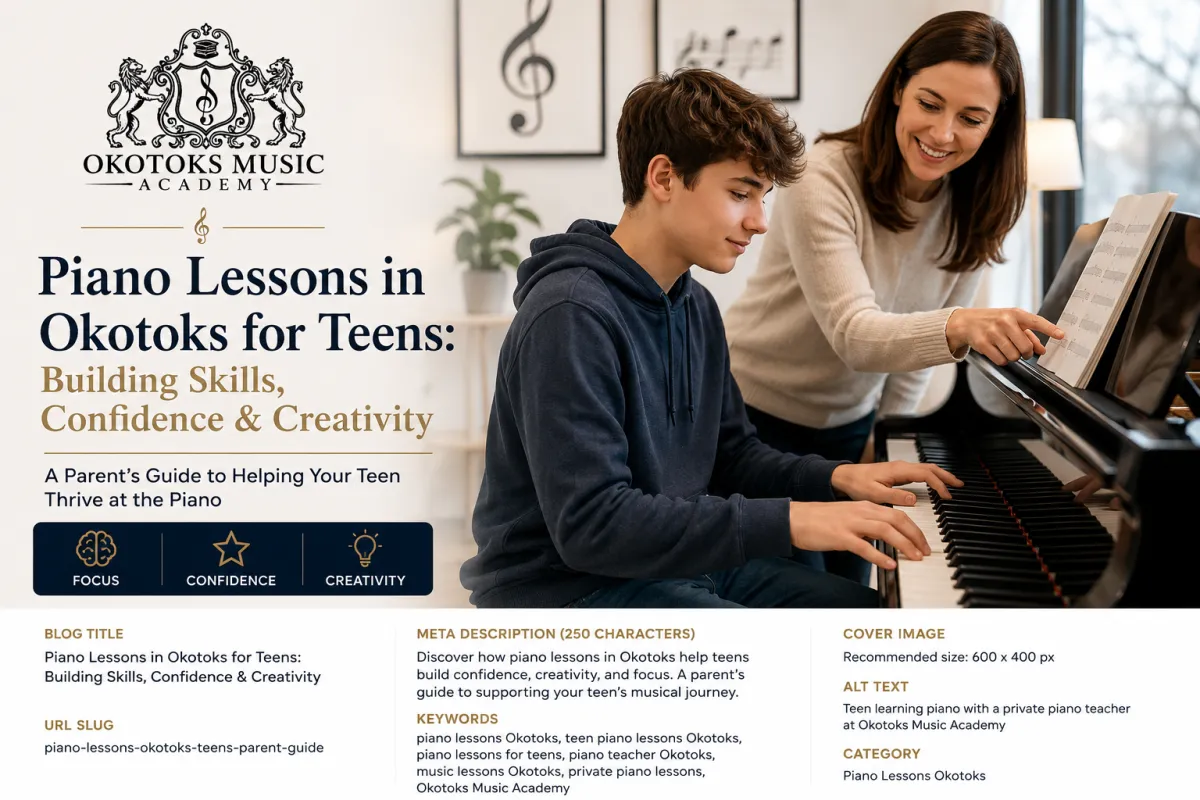
Piano Lessons in Okotoks for Teens: Building Skill, Confidence, and Creativity
Piano Lessons in Okotoks for Teens: Building Skill, Confidence, and Creativity
Teenagers are at a unique stage of life.
They are old enough to have opinions, preferences, goals, and musical taste of their own. They may be drawn to pop music, film music, worship music, video game themes, songwriting, classical piano, musical theatre, jazz, or simply the idea of learning an instrument for themselves.
At the same time, many teens are busy. School, sports, part-time jobs, friends, homework, church, family commitments, and screen time all compete for attention.
That is why piano lessons for teens in Okotoks need to be handled differently than piano lessons for young children.
A teen does not usually want to be treated like a little kid. They also do not want lessons that feel stiff, outdated, or disconnected from the music they actually care about. For teen students, the best piano lessons combine structure with personal interest. They need enough discipline to make real progress, but enough flexibility to feel personally meaningful.
At Okotoks Music Academy, private piano lessons for teens are designed to help students build musical skill, confidence, independence, creativity, and focus. Some teens start with no experience. Others return to piano after quitting years earlier. Some want to play for fun. Others want to prepare for performances, auditions, school music opportunities, worship teams, songwriting, or long-term musicianship.
This guide will help parents and teens understand what to expect from teen piano lessons, why piano can be valuable during the teenage years, and how to make lessons successful.
Are Piano Lessons Still Worth Starting as a Teen?
Yes. Teens can absolutely start piano lessons, even if they have never played before.
Many parents worry that their child is “too old” to begin piano. That belief is common, but it is not accurate. While younger children may have more years ahead of them to develop gradually, teenagers often have advantages that younger students do not.
Teens usually understand instructions faster. They can focus for longer periods. They may have stronger motivation because they chose the instrument themselves. They often know what kind of music they enjoy. They can make connections between music, emotion, creativity, and personal identity in a way younger children may not yet understand.
A 14-year-old beginner may progress very quickly if they are motivated and consistent.
The bigger issue is not age. The bigger issue is whether the lessons are designed in a way that respects the teen’s stage of life.
Teen piano students need:
clear goals
music that interests them
technical foundations
some control over song choices
a teacher who treats them maturely
realistic practice expectations
encouragement without pressure
structure without making lessons feel childish
Starting piano as a teen can be a very good decision. The student may not become a concert pianist overnight, but that is rarely the point. The point is to build a real musical skill that can serve them for years.
Why Piano Lessons Are Valuable for Teenagers
Teenagers need more than activities. They need places where they can build identity, confidence, and discipline.
Piano gives teens a productive outlet. It is creative, but it also requires focus. It is expressive, but it also requires structure. It gives students something they can work on privately, improve over time, and eventually share with others if they choose.
For many teens, music becomes a healthy form of stress relief. They can sit at the piano and play something that matches their mood. They can work through a difficult section and experience the satisfaction of solving it. They can learn a song they genuinely like and feel ownership over their progress.
Piano lessons can help teens develop:
confidence
patience
emotional expression
creativity
focus
discipline
performance skills
independence
problem-solving
musical taste
self-motivation
These are not small benefits.
Teenagers are often under pressure to perform academically, socially, and athletically. Piano gives them a different type of growth. It is not only about winning, scoring, or being compared. It is about developing a skill over time.
That kind of long-term progress can be powerful.
What Makes Teen Piano Lessons Different from Kids Piano Lessons?
Teen piano lessons should not feel like a children’s program with older students plugged into it.
A teen beginner still needs fundamentals, but the tone and approach should be different.
Younger children often need more games, repetition, and basic motor-skill development. Teens can usually handle more explanation, more choice, and more direct conversation about goals.
A good teen piano teacher may ask:
What music do you actually listen to?
Do you want to learn songs, chords, reading, theory, or all of it?
Are you interested in songwriting?
Do you want to perform?
Do you want to play for yourself?
Do you want to improve for school, church, auditions, or personal enjoyment?
How much time can you realistically practice each week?
This matters because teen motivation is different from young-child motivation.
A 7-year-old may be motivated by stickers, games, and parent encouragement. A teenager is more likely to be motivated by personal relevance. They need to understand why they are learning something.
If a teen understands that scales help them play faster, chords help them learn songs, rhythm helps them sound better, and theory helps them create music, they are more likely to engage.
Teen piano lessons should respect that.
Beginner Piano Lessons for Teens: What Do They Learn First?
A teen beginner does not need to feel embarrassed about starting from the beginning.
Every musician starts somewhere.
In the first stage of teen piano lessons, students usually learn:
Keyboard Layout
Students learn how the piano is organized, where the notes are, and how patterns repeat across the keyboard.
This gives them confidence quickly because the instrument begins to make sense.
Basic Technique
Good technique matters. Students learn posture, hand shape, finger numbers, relaxed movement, and how to avoid unnecessary tension.
This is especially important for teens who may want to play faster songs later.
Rhythm
Rhythm is essential for every style of music. Students learn how to count, feel a steady beat, and play with accuracy.
Note Reading
Reading music gives students independence. It allows them to learn songs more accurately and understand written music.
Some teens may start with reading right away. Others may combine reading with chord-based playing depending on their goals.
Chords
Chords are especially useful for teens because they unlock a large amount of music quickly. Many pop, worship, and contemporary songs are built around chord progressions.
Learning chords can help teen students feel like they are playing “real music” early.
Simple Songs
Early songs should be achievable. Teens need success quickly, especially if they are self-conscious about being beginners.
Practice Skills
Teens need to learn how to practice efficiently. That includes slowing down, isolating difficult sections, repeating correctly, and setting small goals.
A good teacher does not just say, “Practice this.” They teach the student how to practice.
Can Teen Piano Students Learn Popular Songs?
Yes. In fact, popular music can be a very effective motivator for teen piano students.
Many teens are drawn to piano because they want to play songs they already know. That may include pop songs, movie themes, video game music, worship songs, musical theatre pieces, or music they hear online.
This can be useful, but it needs to be handled properly.
A teacher should not only hand the student a difficult arrangement and hope for the best. The teacher should help the student find music that matches their current level while gradually building skill.
Popular music can teach:
chords
rhythm
left-hand patterns
melody
accompaniment
ear training
expression
song structure
creativity
For example, a teen who wants to learn a favourite pop song may also learn about chord progressions, inversions, rhythm patterns, and how to accompany a singer.
That is real musicianship.
The key is balance. Teens should be allowed to learn music they enjoy, but they should also build enough foundation to keep improving.
Piano Lessons for Teens Who Took Lessons Before and Quit
Many teens return to piano after stopping earlier in childhood.
This is common.
A student may have quit because they were too young, too busy, not interested at the time, mismatched with a teacher, or frustrated by practice. But later, as a teenager, they may become interested again.
Returning students often feel awkward. They may think they “should be better” because they took lessons before. They may remember some things but feel rusty.
That is normal.
A good teacher can assess where the student is now without making them feel judged. Some skills may come back quickly. Others may need rebuilding. The goal is not to shame the student for stopping. The goal is to restart in a way that works better this time.
For returning teen students, lessons may include:
rebuilding reading skills
reviewing rhythm
improving technique
learning chords
choosing more mature music
filling gaps from earlier lessons
setting new goals
Sometimes the second attempt works better than the first because the student is older and more invested.
Piano as a Confidence Builder for Teens
Confidence is not built by empty praise. It is built by evidence.
A teen becomes more confident when they can look at something they could not do before and say:
“I learned that.”
Piano creates these moments regularly.
At first, a song may look impossible. Then the student breaks it into sections. They slow it down. They repeat it. They make mistakes. They fix those mistakes. Eventually, they play it better than they did the week before.
That process teaches something valuable.
It teaches teens that improvement is possible.
This matters beyond music. A teenager who learns to work through a difficult piano piece may also become more patient with schoolwork, sports, jobs, or other challenges. Piano becomes a controlled place to practice perseverance.
For shy teens, piano can also provide a quiet form of self-expression. They do not have to be loud or outgoing to develop confidence. They can build it through skill.
For high-achieving teens, piano can provide a healthy challenge that is not tied to grades. For anxious teens, it can provide routine and focus. For creative teens, it can become a tool for expression.
This is why teen piano lessons in Okotoks can be about much more than simply learning notes.
How Much Should Teens Practice Piano?
Teen students can usually handle more focused practice than younger children, but they are also busy.
A realistic starting point for many teen beginners is 15 to 30 minutes per day, several days per week.
More advanced or highly motivated teens may practice longer.
The most important factor is consistency.
A teen who practices 20 minutes, 5 days per week, will usually progress faster than a teen who practices once for 90 minutes the night before the lesson.
Practice does not always need to be long, but it should be focused.
A strong teen practice session may include:
warm-up or technique
review of last week’s material
slow work on difficult sections
rhythm counting
chord practice
one enjoyable song
a short goal for the next session
Parents do not need to micromanage teen practice. In fact, too much parental pressure can sometimes make teens resist.
A better approach is to help create structure.
Ask:
“When are you planning to practice this week?”
“What song are you working on?”
“Do you need time protected from other distractions?”
“Is the lesson still feeling useful?”
For teens, ownership matters. Parents can support the routine without turning music into a fight.
Do Teens Need a Piano or Keyboard at Home?
Yes. A teen student needs an instrument at home to make progress.
For beginners, a quality digital piano or keyboard may be enough to start, especially if it has full-size keys and touch sensitivity. Weighted keys are better if possible.
A small toy-style keyboard is not ideal.
Teen students benefit from an instrument that feels close enough to a real piano that they can build proper technique and expression.
Families should look for:
full-size keys
touch-sensitive keys
weighted keys if budget allows
a stable stand
a proper bench or seat height
a sustain pedal
headphones if needed for quiet practice
A good home setup removes friction. If the keyboard is packed away in a closet, practice is less likely to happen. If it is ready to play, the student is more likely to sit down and use it.
Piano Lessons, Songwriting, and Creativity
Teenagers often connect with music as a form of personal expression.
Piano is especially useful for songwriting because it shows harmony, melody, and structure clearly. A student can learn chords, create progressions, build melodies, and experiment with sound.
Even a beginner can start exploring simple creative ideas.
Teen piano lessons may include:
chord progressions
improvisation
melody writing
lyric support
accompaniment patterns
arranging simple songs
playing by ear
understanding song structure
Not every student wants to compose music, but many teens enjoy having the option.
Creativity can also make lessons feel more personal. Instead of only learning what is on the page, students begin to understand how music is built.
That is a major step.
What If My Teen Is Nervous About Starting?
Many teens feel nervous about starting piano lessons.
They may worry they are too old, too behind, too awkward, or not naturally talented. They may also worry about being compared to younger students who have played longer.
This is understandable, but it should not stop them.
A good private piano teacher will not expect a teen beginner to already know everything. The teacher’s job is to help them begin.
Teen students often do well once they realize lessons are not about embarrassment. Lessons are about progress.
The first few lessons should focus on building comfort, trust, and direction.
The student should leave thinking:
“This is doable.”
That first step matters.
What Should Parents Look for in a Teen Piano Teacher?
Parents should look for a teacher who can connect with teenagers, not just teach piano.
A strong teen piano teacher should be able to:
communicate respectfully
explain concepts clearly
listen to the student’s goals
balance structure with flexibility
include music the student enjoys
teach proper technique
build reading and rhythm skills
support creativity
challenge the student without pressure
encourage independence
The relationship matters.
Teens are more likely to stick with lessons when they feel the teacher understands them. That does not mean the teacher should let the student do whatever they want. It means the teacher should guide them in a way that feels relevant and respectful.
For families searching for a piano teacher in Okotoks, this is important. The right teacher can help a teen see piano not as another obligation, but as a skill worth developing.
Private Piano Lessons vs. Learning Online
There are many online piano tutorials, apps, and videos available. Some are useful. But they are not the same as private instruction.
Online tools cannot always correct posture, hand tension, rhythm problems, finger choices, or misunderstanding. They also cannot easily adapt to the student’s personality, goals, and progress.
A private piano teacher can see what is happening in real time.
They can say:
“Your wrist is tense.”
“Slow that section down.”
“Try this fingering instead.”
“You are rushing the rhythm.”
“This song is too hard right now; let’s use a better arrangement.”
“You are ready for something more challenging.”
That kind of feedback matters.
Online learning can support piano lessons, but for most teens, it should not fully replace a good teacher.
Why Local Piano Lessons in Okotoks Are a Strong Choice for Teens
For busy families, convenience matters.
A local lesson option can make it easier to keep music consistent through the school year. If lessons are too far away or too hard to schedule, students are more likely to stop.
For Okotoks families, local piano lessons can fit more naturally into weekly routines. Students can come after school, in the evening, or around other activities depending on availability.
Local lessons also help teens feel connected to their own community. Music does not have to be something distant or formal. It can be part of normal life in Okotoks.
When parents search for piano lessons near me in Okotoks, they are often looking for more than convenience. They are looking for a place where their teen can grow, feel supported, and develop a real skill.
That is what good music lessons should provide.
Common Questions About Piano Lessons for Teens
Is 13, 14, 15, or 16 too late to start piano?
No. Teenagers can start piano successfully. They may even progress quickly because they can understand instructions, focus longer, and choose music that motivates them.
Can teens learn piano if they cannot read music?
Yes. A teen beginner can learn note reading step by step. Some students also begin with chords and familiar songs while developing reading skills over time.
How long does it take for a teen to play songs?
Many teens can begin playing simple songs within the first few lessons. More complex songs take time, practice, and proper foundation.
Should teens learn classical piano or popular music?
Both can be useful. Classical and method-based learning build technique and reading, while popular music helps motivation and practical playing. A balanced approach is often best.
Can piano help with school stress?
For many teens, yes. Piano can provide a focused, creative break from academic and social pressure. It gives students something productive and expressive to work on.
Do teens need to perform in recitals?
Not every teen wants to perform immediately. Some enjoy it, while others prefer to build confidence first. Performance opportunities can be valuable, but they should be handled in a supportive way.
What if my teen is self-conscious?
That is common. Private lessons can help because the student learns one-on-one without being placed in front of a group. Confidence usually grows as the student sees progress.
Final Thoughts: Piano Can Be a Strong Outlet for Teens
Teenagers need healthy outlets.
They need places to build confidence, express themselves, and develop skills that do not disappear after one season. Piano can provide that.
Whether your teen is brand new to music, returning after years away, interested in popular songs, preparing for school music opportunities, or simply looking for a creative outlet, private piano lessons can help them grow.
The key is finding lessons that are structured enough to build real skill and flexible enough to connect with the student’s actual interests.
At Okotoks Music Academy, we offer private piano lessons for teens in a supportive, one-on-one environment. Our goal is to help students build confidence, focus, creativity, and musical independence.
Okotoks Music Academy offers private music lessons in piano, guitar, and voice for students in Okotoks and surrounding areas.
If your teen is ready to start piano, return to lessons, or build their musical skills, contact Okotoks Music Academy to ask about current lesson availability.
