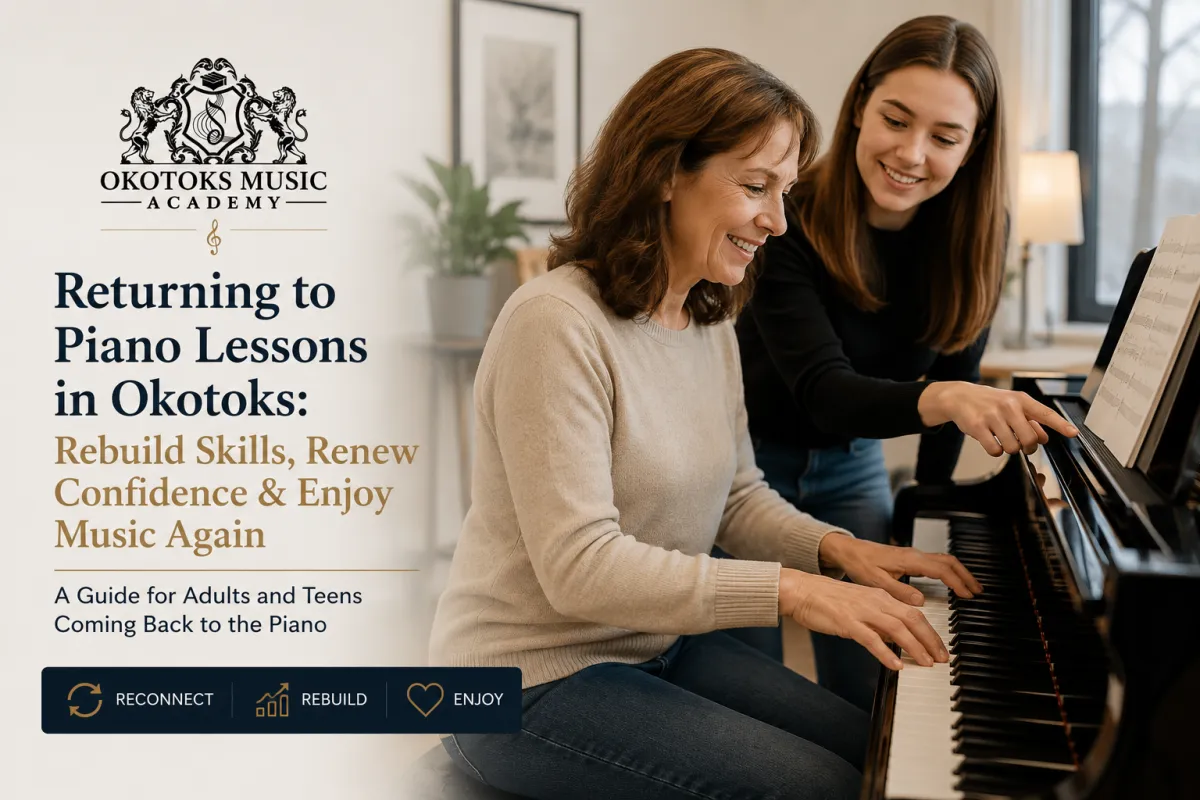
Returning to Piano Lessons in Okotoks: Rebuild Skills, Renew Confidence, and Enjoy Music Again
Returning to Piano Lessons in Okotoks:
Rebuild Skills, Renew Confidence, and Enjoy Music Again
Many people who search for piano lessons in Okotoks are not complete beginners.
Some took piano lessons as children and stopped. Some played through elementary school and quit when sports, school, or teenage life became busy. Some adults remember enough to play a few notes but feel rusty. Some seniors learned years ago and would love to return. Some parents want their child to restart after quitting once before.
If that sounds familiar, you are not alone.
Returning to piano is very common.
Life gets busy. Interests change. Practice becomes difficult. A teacher may not have been the right fit. Lessons may have felt too strict, too boring, too stressful, or too disconnected from the music the student actually wanted to play.
But stopping once does not mean piano is over.
In fact, returning to piano later can be more rewarding than starting the first time. You have more maturity, more perspective, and usually a better idea of what you want from music.
At Okotoks Music Academy, private piano lessons can help returning students rebuild skills, regain confidence, fill in learning gaps, and enjoy music again. Whether you are a teen coming back after a few years, an adult returning after childhood lessons, or a senior wanting to reconnect with music, the right lesson approach can help you start again without embarrassment or pressure.
This guide explains what to expect when returning to piano lessons, why many students come back, and how to make the second chapter stronger than the first.
Why People Stop Piano Lessons
Before talking about returning to piano, it helps to understand why people stop in the first place.
Most students do not quit piano because they are incapable of learning. More often, they quit because something about the situation was not working.
Common reasons people stop piano lessons include:
lessons felt too rigid
practice became stressful
the teacher was not the right personality fit
the student was over scheduled
music choices felt boring
progress felt too slow
the student lacked confidence
family routines changed
sports or school became busier
the student did not understand why they were learning certain things
performance pressure became too high
they simply were not ready at that stage of life
This is important because quitting once does not mean the student failed.
Sometimes the timing was wrong. Sometimes the teaching style was wrong. Sometimes the student needed a different approach.
A child who disliked piano at age 8 may enjoy it at age 14. An adult who quit as a teen may return with stronger motivation. A senior who has not played for decades may find that music brings back joy, memory, and a sense of personal accomplishment.
Returning to piano is not a sign that you failed before.
It is a sign that the interest is still there.
Is It Hard to Return to Piano After Years Away?
It can feel awkward at first, but it is usually not as hard as people fear.
Many returning piano students are surprised by how much they remember. Even if your reading feels slow or your fingers feel clumsy, your brain may still recognize patterns, rhythms, notes, and sounds from previous lessons.
You may notice that:
some songs feel familiar
your hands remember certain patterns
note reading comes back gradually
rhythm improves with review
old habits return, both good and bad
your confidence improves after a few lessons
The first few weeks may feel strange because your memory and your current ability may not match.
You might remember playing better than you can play right now. That can be frustrating.
But that is normal.
The goal is not to instantly return to your old level. The goal is to rebuild steadily.
A good piano teacher will not make you feel embarrassed for being rusty. They will assess where you are now and help you move forward from there.
Returning Students Have an Advantage
Returning piano students often underestimate themselves.
They focus on what they forgot instead of what they still have.
But returning students have real advantages.
You may already understand:
basic keyboard layout
note names
rhythm concepts
hand position
practice routines
simple songs
music terminology
how lessons work
Even if these skills feel weak, they often come back faster than they would for someone starting from zero.
Returning students also have life experience. Teens may understand their musical taste better than they did as young children. Adults may have stronger patience and motivation. Seniors may have more time and a deeper emotional connection to music.
That matters.
The second time around, piano does not have to be about pleasing someone else. It can be about personal enjoyment, growth, and connection.
What Should Returning Piano Lessons Focus On?
Returning piano lessons should begin with an assessment, not assumptions.
Some returning students need to review basics. Others can jump forward quickly. Some remember how to read music but struggle with rhythm. Others can play by ear but never learned strong reading skills. Some have good musical instincts but poor technique.
A teacher should identify what is strong, what is missing, and what the student wants to accomplish.
Returning piano lessons may focus on:
Refreshing Note Reading
If you used to read music but now feel slow, that skill can be rebuilt. The teacher may start with easier pieces to rebuild confidence before moving into harder material.
Rebuilding Technique
Your fingers may feel less coordinated than before. You may need to review hand shape, fingering, posture, and relaxed movement.
Fixing Old Habits
Some returning students learned habits that now limit them. A teacher can help correct tension, poor fingering, uneven rhythm, or rushing.
Learning Chords
Many returning students were taught mostly through method books and note reading. Learning chords can open up pop songs, worship music, songwriting, and accompaniment.
Choosing Music You Actually Enjoy
Returning students often do better when they have input into the music. Enjoyable songs can increase motivation.
Filling Theory Gaps
Some students played songs for years without understanding how music worked. Theory can help connect the dots.
Building Confidence Again
Many returning students need emotional confidence as much as technical help. The teacher’s job is to make the restart feel possible.
Returning to Piano as a Teen
Teenagers often return to piano with a different attitude than they had as children.
A younger child may have taken lessons because a parent chose it. A teenager may return because they now want to play certain songs, write music, join a worship team, prepare for school music opportunities, or have a creative outlet.
That shift matters.
Teen returning students may be motivated by:
pop songs
movie music
worship music
musical theatre
video game music
songwriting
playing with friends
school performances
personal stress relief
wanting to finish what they started
The teaching approach should respect that.
A teen who returns to piano should not simply be handed the same old beginner book they disliked years ago. They may need review, but the review should be connected to their current goals.
For example, if a teen wants to play popular songs, the teacher can review reading and rhythm while also teaching chords. If the teen wants to write music, the teacher can connect theory to songwriting. If the teen wants to improve for school music, lessons can focus on reading, confidence, and performance preparation.
Returning teens often do well when they feel ownership.
Returning to Piano as an Adult
Adults often return to piano with mixed feelings.
They may feel excited, but also self-conscious. They may say things like:
“I used to play, but I forgot everything.”
“I wish I never quit.”
“I probably should be better than this.”
“I’m nervous to start again.”
“I only remember a few songs.”
“I took lessons as a kid, but I hated practicing.”
“I want to play for myself this time.”
These are common.
Adult returning students need a teacher who understands that the restart is not just technical. It is emotional too.
Many adults carry old memories around piano. Some were pressured too much. Some had teachers who were too strict. Some felt compared to siblings. Some quit and felt guilty. Others simply regret not continuing.
A better restart should not repeat the same pattern.
Adult piano lessons should be practical, respectful, and goal-focused. You can review fundamentals while also working toward music that actually matters to you.
That may include:
worship songs
Christmas music
old favourites
pop songs
classical pieces
family songs
simple accompaniment
music for personal relaxation
songs to play for children or grandchildren
Returning as an adult can be deeply rewarding because you are choosing it for yourself.
Returning to Piano as a Senior
Seniors and retirees often return to piano because they finally have more time, or because music has always stayed close to the heart.
Some seniors played when they were young and want to reconnect. Others took a few lessons years ago and want to try again. Some want to keep the mind active. Others want to play hymns, favourite songs, or music connected to family memories.
Piano lessons for returning seniors should be patient and adaptable.
A senior student may benefit from:
slower pacing
larger print music
familiar songs
repetition
chord-based playing
review of reading basics
relaxed lesson expectations
focus on enjoyment
confidence-building
The goal is not pressure. The goal is meaningful progress.
For many seniors, piano becomes part of a weekly rhythm. It gives the mind something to work on, the hands something to do, and the heart something to enjoy.
That is a good reason to return.
What If You Quit Because Practice Was Stressful?
This is one of the biggest reasons people stop piano.
Practice becomes a battle. The student feels pressured. Parents become frustrated. The teacher assigns too much. The songs feel boring or too difficult. Eventually, the student connects piano with stress.
If that happened before, returning to piano should include a better practice plan.
Practice does not need to be long to be effective.
For returning students, a good starting routine may be:
10 to 20 minutes per day
4 to 5 days per week
one clear assignment
one small technical goal
one enjoyable song
slow practice on difficult sections
no cramming the night before lessons
For younger students, parents should help create routine without turning practice into punishment.
For teens and adults, the student should have more ownership.
A better practice experience can completely change how someone feels about piano.
Should Returning Students Start From the Beginning?
Sometimes yes. Sometimes no.
This depends on the student.
Some returning students need to restart with beginner material for a short time. That does not mean they are “back at zero.” It simply means the teacher is rebuilding the foundation.
Other students can review quickly and move into more advanced material.
The decision should be based on:
current reading ability
rhythm accuracy
hand coordination
technique
confidence
musical goals
how long it has been since lessons
what the student remembers
what gaps need fixing
The worst approach is to push too fast because the student “used to play.”
That can create frustration.
The better approach is to start where the student is now, build confidence, and move forward at the right pace.
How Long Does It Take to Get Back Into Piano?
Returning students often regain skills faster than complete beginners, but the timeline varies.
A student who stopped for one year may return quickly. Someone who stopped for 20 years may need more review. A student who practiced well before quitting may regain confidence faster than someone who had gaps from the start.
A realistic timeline may look like this:
First few lessons:
The teacher assesses current level, reviews basics, and identifies goals.
First month:
The student rebuilds comfort at the keyboard and starts regaining routine.
First 3 months:
Reading, rhythm, coordination, and confidence improve noticeably.
First 6 months:
The student may begin feeling like piano is part of life again, not just something they used to do.
This is not a race.
The key is steady progress.
Why Private Lessons Help Returning Students
Private piano lessons are especially helpful for returning students because every student comes back with a different history.
One student may have strong reading but weak chords. Another may have good ear skills but poor rhythm. Another may remember songs but struggle with technique. Another may be nervous because of a negative past lesson experience.
A private teacher can adapt.
They can choose material based on the student’s current level, not just age or past experience.
Private lessons also allow returning students to ask questions without feeling embarrassed in a group. That matters, especially for adults and teens.
For anyone searching for private piano lessons in Okotoks, returning to lessons is one of the strongest reasons to choose a one-on-one format.
How to Make Returning to Piano Successful
A successful return to piano depends on more than the lesson itself.
Here are some practical ways to make the restart work.
Be honest about your past experience
Tell the teacher what you remember, what frustrated you before, and what you hope will be different this time.
Choose realistic goals
Do not expect to play everything immediately. Start with achievable goals and build momentum.
Practice consistently
Short, regular practice is better than occasional long practice.
Include music you enjoy
Enjoyment matters. It helps you stay connected.
Do not compare your current playing to your old playing
You are rebuilding. Give yourself time.
Let the teacher fill gaps
Even if review feels simple, it may be necessary. Strong foundations make future progress easier.
Stay patient
The first few weeks may feel awkward. That does not mean it is not working.
Common Questions About Returning to Piano Lessons
Will I remember how to play piano?
You may remember more than you think. Some skills come back quickly, while others need review. A teacher can help you rebuild step by step.
Am I too old to return to piano?
No. Adults and seniors can return to piano successfully. It is never too late to rebuild a musical skill.
What if I quit because I was not progressing?
A different teacher, better practice plan, clearer goals, and more suitable music can make a major difference.
Should my child restart piano if they quit before?
Possibly. If the child is interested again, restarting can work well. The key is understanding why they quit and adjusting the approach.
Do I need to start from the first beginner book again?
Not always. A teacher should assess your current ability and choose the right starting point.
Can I learn different music this time?
Yes. Returning students often do well when lessons include music they actually enjoy.
How often should returning students take lessons?
Weekly lessons are usually best because they provide structure, accountability, and steady progress.
Do I need a piano at home?
Yes, regular practice is important. A digital piano or quality keyboard can work well for many returning students.
Final Thoughts: Your Piano Story Is Not Finished
If you used to play piano, quit, and have thought about returning, that interest probably means something.
Maybe you miss the music. Maybe you regret stopping. Maybe you want to prove to yourself that you can start again. Maybe you want your child to restart with a better experience. Maybe you simply want music back in your life.
Whatever the reason, returning to piano is a worthwhile step.
You do not need to be perfect. You do not need to remember everything. You do not need to explain why you stopped.
You only need to begin again.
At Okotoks Music Academy, we offer private piano lessons for returning students, including teens, adults, seniors, and students who previously took lessons and want a fresh start. Our goal is to help you rebuild skill, confidence, and enjoyment in a supportive one-on-one environment.
Okotoks Music Academy offers private music lessons in piano, guitar, and voice for students in Okotoks and surrounding areas.
If you are ready to return to piano lessons in Okotoks, contact Okotoks Music Academy to ask about current lesson availability.
