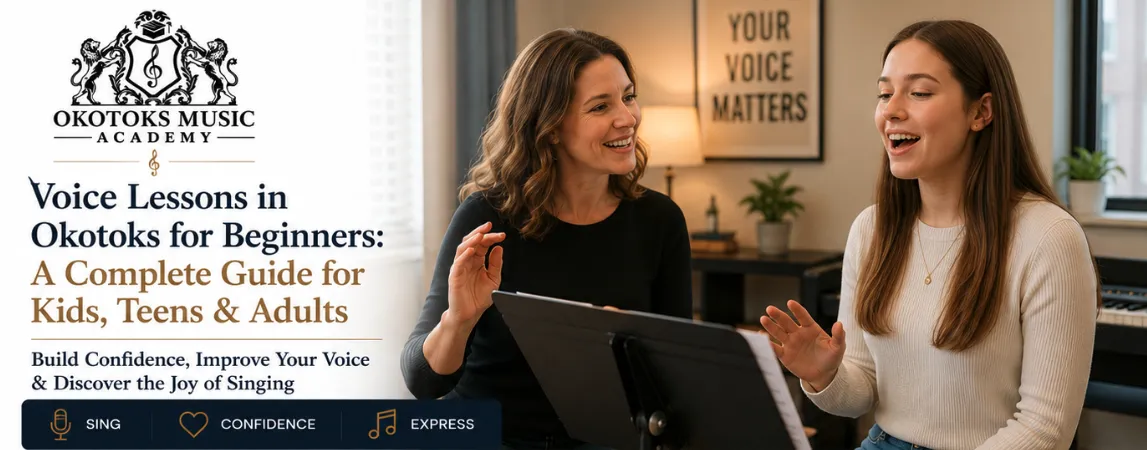
Voice Lessons in Okotoks for Kids: Helping Young Singers Build Confidence
Voice Lessons in Okotoks for Kids:
Helping Young Singers Build Confidence
Some children love to sing from the moment they can talk.
They sing in the car, around the house, at church, during movies, while doing chores, or while making up songs of their own. Other children are quieter. They may love music but feel shy about singing where anyone can hear them.
Both types of children can benefit from voice lessons.
If you are searching for voice lessons in Okotoks for your child, you may be wondering whether singing lessons are the right fit. Maybe your child has a strong interest in singing. Maybe they want to perform. Maybe they are involved in choir, musical theatre, worship, school performances, or simply enjoy music. Or maybe you want to help them build confidence, projection, listening skills, and healthy vocal habits.
Voice lessons can help with all of that.
At Okotoks Music Academy, private voice lessons for kids are designed to help young singers build confidence, improve pitch, learn healthy breathing, develop rhythm, and enjoy singing in a positive one-on-one setting. The goal is not to pressure children into becoming performers before they are ready. The goal is to help them understand their voice, use it safely, and grow in confidence.
This parent guide explains what kids learn in beginner voice lessons, when children should start, how singing lessons help shy students, and what parents should expect.
Are Voice Lessons Good for Kids?
Yes. Voice lessons can be very good for children when they are taught in an age-appropriate and healthy way.
Children use their voices constantly. They speak, sing, laugh, call to friends, participate in class, and express emotion through sound. Voice lessons can help children become more aware of how they use their voice.
Good singing lessons can help kids develop:
confidence
pitch accuracy
listening skills
breathing habits
clear pronunciation
rhythm
musical expression
stage presence
posture
focus
self-awareness
healthy vocal habits
Voice lessons are not only for children who already sound “talented.” They are also for children who want to improve.
A child does not need to have a perfect voice before starting. Lessons are where the skill develops.
This is important for parents to understand. Some children are naturally expressive. Others need encouragement and guidance. Both can grow.
What Age Should Kids Start Voice Lessons?
Many children are ready for beginner voice lessons around ages 6 to 8, but readiness depends on the child.
Voice is different from piano or guitar because the instrument is the body. A child’s voice is still developing, so lessons should focus on safe, gentle, age-appropriate singing.
A child may be ready for voice lessons if they can:
follow simple instructions
focus with a teacher for a short lesson
copy simple sounds or melodies
show interest in singing
sing without forcing or yelling
handle gentle correction
participate in simple warmups
enjoy music and rhythm
Younger children may do best with playful, light singing activities, simple songs, movement, echo patterns, and confidence-building exercises.
Older children can usually handle more structure, including breathing, pitch matching, rhythm, song interpretation, and performance skills.
The key is that children should not be pushed into adult-style vocal training. Their voices need age-appropriate instruction.
What Do Kids Learn in Beginner Voice Lessons?
Beginner voice lessons for children should be clear, encouraging, and practical.
A young singer may learn:
Breathing Basics
Children learn how breathing supports singing. This does not need to be complicated. They may learn how to take calm, low breaths and avoid shallow, tense breathing.
Posture
Good posture helps the voice work more freely. Students learn how to stand or sit in a way that supports singing without becoming stiff.
Pitch Matching
Pitch matching means learning to sing the correct note. Some children do this naturally. Others need practice. Voice lessons can help students listen carefully and adjust their voice.
Rhythm
Singing is not just about notes. It also requires timing. Students may clap, count, move, or speak rhythms before singing them.
Warmups
Age-appropriate warmups help children prepare their voice. These should be gentle and safe.
Clear Words
Students learn how to sing words clearly so lyrics can be understood.
Expression
Singing is communication. Children learn how to express the mood and meaning of a song.
Confidence
Confidence is a major part of voice lessons. Students learn to sing out, try again, and become comfortable using their voice.
Song Preparation
Students work on songs that fit their age, range, and ability.
The goal is not to make children sound like adults. The goal is to help them sing naturally, safely, and musically.
Can Voice Lessons Help a Shy Child?
Yes. Voice lessons can be especially helpful for shy children.
Some parents assume voice lessons are only for outgoing kids who already love performing. That is not true.
A private voice lesson can be a safe place for a quiet child to build confidence one step at a time. The student does not have to sing in front of a large group. They can work with one teacher, build trust, and slowly become more comfortable.
A shy child may start by singing softly. They may avoid eye contact. They may feel embarrassed when corrected. They may need extra encouragement.
That is normal.
Over time, a supportive teacher can help the child:
sing with more volume
trust their voice
try new sounds
handle mistakes
build comfort
prepare for small performances
express emotion through music
feel proud of progress
Confidence does not happen by forcing a child to be bold. It happens by giving the child repeated evidence that they can do something.
Voice lessons can create that evidence.
Can Voice Lessons Help Kids Sing in Tune?
Yes. Voice lessons can help children improve pitch.
Some children naturally match pitch well. Others struggle to hear whether they are singing too high, too low, or on the correct note.
That does not mean they cannot learn.
Pitch matching is a skill.
A voice teacher may use:
echo singing
simple scales
call-and-response exercises
piano support
listening games
familiar songs
short melodic patterns
movement
visual cues
Children often improve when they learn how to listen more carefully and adjust their voice.
Parents should be careful not to label a child as “tone deaf.” True tone deafness is rare, and many children who seem off-pitch simply need training, confidence, and practice.
A child who struggles with pitch may become discouraged if adults laugh, criticize, or compare. A good teacher can help correct pitch in a kind and constructive way.
Are Voice Lessons Safe for Children?
Voice lessons are safe when they are taught properly.
Children should not be pushed to sing too high, too loud, too long, or with adult-style intensity. Their voices are still developing.
Healthy children’s voice lessons should avoid:
yelling
forced belting
straining
copying adult singers too aggressively
singing outside a comfortable range
long, intense vocal drills
pressure to sound older
ignoring vocal discomfort
Instead, lessons should focus on:
relaxed singing
comfortable range
healthy breathing
clear tone
good posture
gentle warmups
age-appropriate songs
musical confidence
If a child’s voice feels sore after singing, that should be addressed. Singing should not regularly cause pain.
A good voice teacher will help students learn healthy habits early.
What Types of Songs Can Kids Sing in Voice Lessons?
Children can sing many styles, but the songs should fit their age, range, and ability.
Possible song styles include:
children’s songs
musical theatre
Disney-style songs
worship songs
folk songs
pop songs
seasonal songs
recital songs
school performance songs
simple classical-style songs
Song choice matters.
A song may be popular but not appropriate for a young voice. Some songs are too low, too high, too mature, too rhythmically difficult, or too vocally demanding.
A good teacher can help choose songs that are both enjoyable and suitable.
Children should have some input, but the teacher must guide the choice.
The best song is one that the child enjoys and can sing safely.
Private Voice Lessons vs. Choir
Choir and private voice lessons are both valuable, but they are different.
Choir teaches students to sing with a group. It helps with blending, listening, harmony, teamwork, and following a director.
Private voice lessons focus on the individual singer.
In private lessons, the teacher can work on:
the child’s specific voice
pitch issues
breathing
confidence
posture
song choice
vocal habits
performance preparation
expression
individual goals
A child in choir may still benefit from private voice lessons because they receive personal feedback that is difficult to provide in a group setting.
A child who takes private lessons may also benefit from choir because they learn to sing with others.
They are not competing options. They can support each other.
How Much Should Kids Practice Singing?
Children should practice singing in short, healthy amounts.
For young beginners, 5 to 15 minutes, several days per week, is usually enough.
Practice should not involve yelling, forcing high notes, or singing until the voice feels tired.
A good practice routine may include:
gentle warmup
breathing exercise
one pitch exercise
lyrics review
singing one short section of a song
practicing clear words
ending with an enjoyable song
Parents can help by encouraging practice without turning singing into pressure.
Better questions include:
“Can you show me the song you worked on?”
“What did your teacher ask you to practice?”
“What part feels easiest?”
“What part feels tricky?”
“Do you want to sing it for me, or just practice privately today?”
Some children love singing for others. Some do not. Respect matters.
What If My Child Wants to Perform?
Performance can be a great goal, but it should be handled carefully.
Some children are excited to perform. Others are nervous. Some need time before singing in front of others.
Voice lessons can help prepare students for:
recitals
school concerts
church singing
auditions
musical theatre
choir solos
family performances
community events
Performance skills may include:
standing confidently
using a microphone
introducing a song
managing nerves
remembering lyrics
singing with accompaniment
recovering from mistakes
expressing the song
The goal is not to force performance. The goal is to prepare the child so that if they do perform, they feel more confident and supported.
What Makes a Good Voice Teacher for Kids?
A good children’s voice teacher needs more than singing ability.
They need to understand children, communication, vocal health, and confidence-building.
A strong voice teacher should be able to:
teach age-appropriate technique
protect the child’s voice
explain clearly
encourage without pressure
correct pitch kindly
choose suitable songs
build confidence slowly
help shy students feel safe
communicate with parents
make lessons structured and positive
The teacher should never shame a child’s voice.
Children are sensitive about singing because the voice feels personal. Criticism can feel like criticism of the child themselves.
A good teacher corrects in a way that helps the student feel capable.
For parents searching for a singing teacher in Okotoks, this is one of the most important factors.
Why Local Voice Lessons in Okotoks Matter
Local lessons make consistency easier.
For Okotoks families, a nearby voice lesson option can help music fit into the weekly routine without adding unnecessary travel stress.
But local is not only about convenience.
Families searching for singing lessons near me in Okotoks are usually looking for a safe, encouraging place where their child can grow.
Voice lessons are personal. Children need to feel comfortable with the teacher. Parents need to trust that the lessons are healthy, structured, and age-appropriate.
That is what matters most.
Common Questions About Voice Lessons for Kids
What age should kids start voice lessons?
Many children are ready around ages 6 to 8, depending on focus, interest, and maturity. Lessons should be age-appropriate and gentle.
Does my child need to be a good singer before starting?
No. Voice lessons are for learning. Children do not need to already sound polished or confident.
Can voice lessons help my child sing in tune?
Yes. Pitch matching can improve with listening exercises, vocal practice, and teacher guidance.
Are singing lessons safe for young voices?
Yes, when taught properly. Children should not be pushed to strain, yell, or sing like adults.
Can shy children take voice lessons?
Yes. Private voice lessons can be a safe way for shy children to build confidence gradually.
Should my child take choir or private voice lessons?
Both can help. Choir teaches group singing, while private lessons provide individual feedback and personal vocal development.
How often should kids take voice lessons?
Weekly private lessons are usually best for steady progress and consistency.
What styles can kids sing?
Children may sing musical theatre, worship, pop, folk, seasonal songs, school songs, or age-appropriate music chosen with the teacher.
Final Thoughts: Voice Lessons Can Help Kids Find Confidence
Voice lessons can be powerful for children because singing is personal.
A child’s voice is part of who they are. When they learn to use it with more confidence, that can affect more than music. It can help them speak up, express emotion, participate in performances, and feel proud of progress.
The right voice lessons should be healthy, encouraging, and age-appropriate.
At Okotoks Music Academy, we offer private voice lessons for children and beginners in a supportive one-on-one environment. Our goal is to help students build confidence, improve pitch, learn healthy vocal habits, and enjoy singing.
Okotoks Music Academy offers private music lessons in piano, guitar, and voice for students in Okotoks and surrounding areas.
If your child is ready to start voice lessons in Okotoks, contact Okotoks Music Academy to ask about current lesson availability.
